
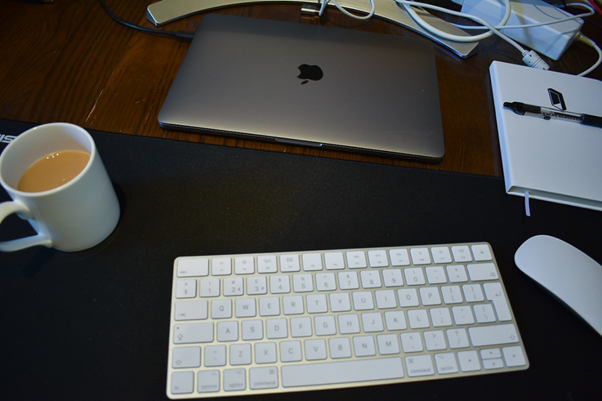
As you’ll know from my previous blog post, I recently transformed the upper staircase landing space to fit my office and the laundry. Whilst I believe this to be the first step in creating a more comfortable and efficient workspace, the other challenge is staying focused and being productive.
At the beginning of this week, I struggled with having the motivation to do things. I became angry at myself for not completing everything which was on my to-do list and I had negative self-inflicting thoughts such as feeling as if I had let down my co-workers and the people in my household. Later this week, I decided to implement the below strategies and do the second half of the week differently. These below tips will help you to stop procrastination and feeling like giving up when working from home is starting to feel lonely and frustrating…
This post is for the professionals who are still trying to carry on doing their job despite uncertainty from clients and businesses, the individuals who are taking the journey to create their own business or side hustle and the students who have exams but have lost motivation to revise and keep up their studies.
Personally, in all honesty, I do not like working from home. Before the COVID-19 outbreak, I would occasionally work from home (if I had a doctor’s appointment, had to sort my flat out or it wasn’t necessary to be at the client’s office) because my job permitted me the flexibility to work wherever. I’m the type of girl who enjoys having lunch with co-workers at the amazing street food markets in Farringdon or doing the coffee run on Fleet Street for my team and working in an office environment where I can catch up with 10+ people in one day.
The biggest obstacles with working from home are:
- Distractions from your partner, TV, children and having 24/7 access to Netflix.
- Difficulty in setting up a routine. There’s no commuting – it’s just from bed to desk.
- What to do during your lunch break and when and how often to take breaks
- Efficiency – sometimes things take longer to do when you are WFH
- Not being able to switch off properly because you’re working in the same place you are chilling
Below I have outlined specific actions you can take to be more productive. I hope this will help you to remain motivated to do your job and provide a basis for a structure for your working day (my tips are in chronological order for how I think you should go about your day):
![]() 1. Make an effort to get dressed for work (try to wear outfits you’d actually wear in public or the office).
1. Make an effort to get dressed for work (try to wear outfits you’d actually wear in public or the office).

The biggest tip I could give you which would shift your mindset from feeling sluggish and lazy to feeling like Elle Woods from Legally Blonde is dedicating 30 minutes in the morning to getting ready to “work”. I understand that pyjamas are super comfy to stay in and you think you are saving time but I always feel like I don’t get as much work done purely because I do not have the same professional mind-set. I’d highly recommend wearing maxi floral summer dresses, jogging bottoms from brands such as Ralph Lauren, Tommy Hilfiger, and Calvin Klein, wide-leg trouser pants and sweatshirts! If you are missing your onesie or favourite patterned PJ bottoms you can dedicate a weekend day to just staying in your pyjamas or Friday dress-down can now be known as wearing PJs.
If you have a conference call, meeting, training or any important phone calls this should be what drives you to make extra effort to wear a smart blouse and comfortable trousers or for men, a polo shirt or linen shirt with comfortable jeans.
2. Start work at the time you’ve established and finish at the time you’ve set

Everyone will have different working patterns and that is fine. In my job, it’s very much project focused and the client is at the heart of what we do – my working hours are dictated on what the timeline of the audit is and financial reporting deadlines. In this current climate, our timetables have changed due to businesses being massively impacted by COVID-19, so I know that I will not be working extremely long hours and I’ll be doing a 9-5 pm day Monday-Friday.
Make sure you have the discussion with your employer on what their expectation is for the work you will be doing and what the standard working hours should be. Keep having these conversations because things can change from week to week.
If you are working on a reduced hours basis – stick to those hours and make sure this is agreed with your employer.
Otherwise do a 9 am – 5 pm job. If you are struggling to finish everything in that time by running over: start scheduling tasks into outlook calendar so that reminders can pop up and put an alarm on at 5 pm to remind you that the working day is over. In an office, it’s easier to know when the day is coming to an end; people are telling you physically goodbye and getting up from their desks and packing up.
3. Check emails, create a daily to-do list or update your Trello Board or any organisational apps/pads you use.

Having a moment to cleanse your mind from all the things you need to do is one of the most exhilarating mind exercises you can do in the morning.
For individuals who are delegated work: check your inbox and flag all emails which contain a task for you to complete. Write this down on a weekly desk pad, notebook or download my Daily WFH To-do list tracker below! It’s specifically for people who are juggling a lot of admin tasks, conference calls, meetings, and their office job!
If you prefer using technology to organise your life, I highly recommend using Trello and MyLifeOrg 3 App.
I prefer using a weekly plan that is undated because it does not tie you down to completing everything on your daily to-do list. The number of times I would get disheartened that I didn’t do 5 things in one day or cross off everything I had on my list was taking too much of a toll on my mental health. Instead, I switched to focussing on the bigger picture and just having an overall weekly plan of stuff I needed to get done and instead I’d have days where I’d get maybe one big task done and another day where I’d complete 3 smaller tasks – this was still driving the progress of my projects and clients I was working on.
For individuals who are their own boss: write down anything that is on your mind including the items that you are dreading doing. Sort these tasks by priority and dread level and aim to do at least 3 of these items each day.
4. Listen to meditation or mindfulness audio podcasts before you do your first task (15 minutes)
Abraham Hicks is my favourite type of self-care audio I like to listen on YouTube. She has different lectures for anything you are going through and specific morning rampage guided meditations which help you to relax your mind, eliminate procrastination and shift your mindset into one where you will accept opportunities, feel progress and be more grateful to yourself. When you have a bundle of good energy, this will drive action and motivate you to keep going.
Know that everything is fine and everything we experience in life is to teach us something or to help us improve our situation.
5. Try to block out your time as much as you can ( and factor in any task switches your manager gives)
I read Sarah’s top tips on productivity and I agree with her blocking out her time in each hour for tasks she would complete, exercise, breaks and creative hobbies (i.e blogging).
You need to create a system in place for getting things done and dealing with change and uncertainty (especially if you are relying on Managers delegating your work). In my job, I probably deal with 1-2 task switches in a day, sometimes more. Even having 3-5 conference calls a day can be a factor for impacting your priorities due to having less time.
My Step-by-Step System for blocking time and dealing with task switching:
- Have due dates for your tasks
- Rank the tasks in order of priority
- Block out 30-minute sessions – 1hr sessions to doing a certain task
- Take a 15 minute -30 minute break after you’ve completed an hour or two of work (use the Pomodoro App /Method to help you keep focussed)
- Whenever you have a task switch or an update block out this time to do this (start with an hour but see how long you realistically need for this)
- Keep following the time block and blocking out breaks where you are away from your laptop screen
6. Spend your breaks with your partner or message/ call your co-workers

I’m fortunate enough to have my boyfriend Ryan as my new co-worker for the past month and a bit. Whenever I take a break, I end up having a quick conversation with him about what to have for dinner/lunch or general things or talk about how my day is going.
If you are self-isolating, use your breaks as a time to have conversations with your colleagues or family. Make that phone call or send the message to your friends to make plans. You’ll feel better having a conversation with another human because you’ll feel an increased sense of connection.
In my job, we have daily stand-up calls and check-ins in with our team using Zoom and Skype for Business. Whilst it’s not the full audit room experience, it’s great to see each other’s faces and what their homes look like!
7. If you are feeling unproductive, exercise!
It’s normal to have moments where your motivation and energy levels dip – when this happens do a 10 minutes workout or even choose to take a 30-minute break away from your screen.
Here’s a list of things you can do when you’re feeling unproductive:
- Do a mini home workout
- Quick yoga workout
- Go for a walk in your front/back garden
- Use this time to have your 1 exercise outside the home a day ( walk to the park, walk to a common or open public space)
- Spend 10 minutes on any weights/ exercise equipment you have
When I’m feeling unproductive this is usually when I spot it instantly and make the choice to stretch my legs and walk downstairs to the kitchen to have a snack or spend 10 minutes on the Maxi Climber machine we got from eBay. Make a note of when you have low energy levels and if these are around similar times – block this time out for breaks and exercise. You’ll come back feeling calmer and ready to restart something.
I’d also highly recommend you to take a break or do some form of active exercise when you’ve finished a conference call (it doesn’t need to be a full 30 minute – 1hr session – it can be 10/15 minutes which are spread out through the day and will help you not feel so bad for sitting in home all day).
I hope you found these tips and pointers helpful! If you start implementing all these tips into your normal working day, you’ll be happier and on the right track to getting your work done more efficiently!
HERE’S A FREE GIFT TO HELP YOU START BEING PRODUCTIVE FROM DAY 1!

Don’t know where to begin when the day starts? Download the planner here.
This tracker supports Accountants, professional office job individuals and students with the management of their workload at home.
In the comments box, what do you use to stay productive?


Such good advice! I really thought I would enjoy working from home before all this happened as I am a bit of an introvert, but I really struggled with the lack of structure. I definitely agree that getting dressed helps with having a professional mindset! I also do my make-up, even though I won’t be seeing anyone, as it’s part of the routine of getting ready in the morning.
Thank you for your sweet comment! Yeah I’ve read certain blog posts which have mixed opinions about wearing makeup when not seeing anyone and I do agree it is personal choice. I usually don’t wear a lot of makeup but when I do, I really enjoy it and make an effort. This week, I decided to put makeup on because I was going on a Zoom call with my team to play someg games as a work social. I’m an extrovert but I certainly prefer having 1:1 connections and I struggle with not seeing my teams at work.
Great post with some great advice! I have definitely struggled with this, especially the lack of routine at the moment. So I’ve started telling myself that 10-2 is my new work day! It allows me enough time in the morning to get up and fit in some yoga, crack on with some work for a few hours, and then enjoy the rest of the afternoon without feeling like I’ve wasted it! I’ve also got back into the habit of writing proper to-do lists so that I can keep track of everything that needs doing, and I feel like I’ve accomplished… Read more »
Thank you so much Taylor! It’s so hard to establish a routine when its just not what you are used to doing. That;s great that you’ve established your work day – it’s the first right step. Feel free to download my daily to-do list planner if you want something on your computer and categorised 🙂
It is great that you have fixed up your home a bit to make it a productive workspace. I totally agree with all of these obstacles!! I have so many distractions and it’s hard to really get things done. I love the things that you do to still make life feel normal. It is important that we don’t lose productivity during a time like this. We still need to prove that we can still be effective while working from home. Time blocking and breaks are so important!! Thanks for sharing all of these great tips!
Nancy ♥ exquisitely.me
Thanks Nancy! Its important to try to keep busy and occupied with work and hobbies and self care. I’m still trying to practice what I preach but its difficult – over time , hopefully it will get easier. I’m glad you found this post helpful – feel free to download the Daily WFH Planner if you ever need a pick me up 🙂
This is a super helpful post, I love how you’ve broken it down x x
Thank you so much Amy 🙂